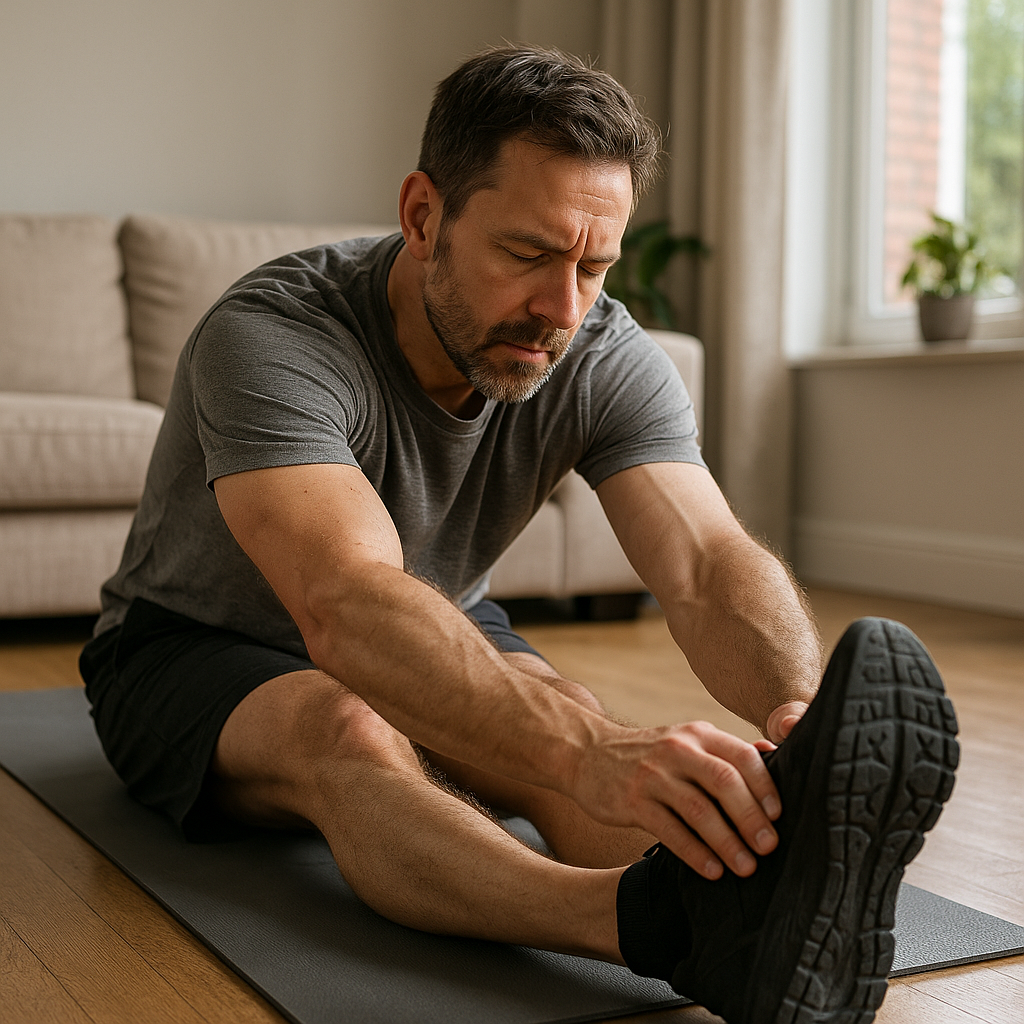
Your hips are a power center. They help you walk, climb stairs, stand up from a chair, and generate force when you run, jump, or lift. And yet, for many of us, the muscles at the front of the hips spend most of the day in a shortened position—thanks to long hours of sitting, driving, and screen time. Over time, that can make a simple hip flexor stretch feel surprisingly intense, even if you’re otherwise active.
When hip flexors get tight, the body often “borrows” movement from somewhere else. The lower back may arch more than it should, the pelvis may tip forward, and your stride can start to feel restricted. The result is a familiar mix of issues: stiff hips, reduced mobility, nagging lower back discomfort, and posture that feels hard to maintain—especially at the end of a long day.

Lumbar support belt
Provides adjustable support and relief for lower back pain and tension.
The good news is that hip flexor stretches can be genuinely transformative when you do them with the right intent. This isn’t about forcing a deep lunge and hoping for the best. It’s about restoring hip extension (your ability to bring the leg behind you), improving how your glutes contribute to movement, and giving your spine a break from compensating. Done consistently, the right approach can help you move more freely, feel more upright, and train with better mechanics.
Why a hip flexor stretch can change how you move
Hip flexors don’t just “feel tight”—they influence how your whole lower body organizes itself. When they’re short and overactive, it can be harder to fully extend the hip, which is a key ingredient in efficient walking, running, and strong glute engagement. That’s why many people notice that after a focused hip flexor stretch routine, they don’t just feel looser—they feel more stable and powerful.
Key benefits of hip flexor stretches
Improved flexibility and range of motion: Better hip extension can make everyday movement smoother and reduce that “stuck” feeling at the front of the hips.
Better performance and glute activation: When the hips can open up, it’s often easier for the glutes to do their job during running, lifting, and single-leg work.
Less tension linked to posture and back discomfort: Many people find that addressing hip tightness helps reduce the urge to over-arch the lower back, which can be a common contributor to lingering discomfort.
Next, we’ll make this practical: how to tell if your hip flexors are actually tight, the most effective hip flexor stretch variations (including beginner-friendly options), and the simple timing rules that help you stay mobile without feeling weaker.
What the science says about hip flexor stretch timing
If you’ve ever wondered whether stretching before training makes you weaker, the answer depends mostly on how long you hold the stretch. Research on hip flexor stretching shows a clear dose-response pattern: shorter static holds tend to maintain performance, while very long holds can slightly reduce strength in the short term.
For warm-ups and “stay powerful” days: Keep total static stretching for each hip flexor to 90 seconds or less. That can look like 20–30 seconds per side for 2–3 rounds. This approach is generally compatible with sprinting, jumping, and strength training.
For cool-downs, rest days, or mobility-focused sessions: Longer holds can be useful if your goal is relaxation and range of motion. Just know that very long stretching bouts (several minutes) may cause a small, temporary dip in strength immediately afterward. That’s why they fit better after training than right before it.
For balance and body awareness: Moderate total stretching time (around a couple of minutes) has also been linked to improvements in balance and proprioception. If you feel “wobbly” on single-leg work, this can be a helpful add-on—especially when paired with controlled breathing and good alignment.
How to tell if your hip flexors are actually tight
Tightness at the front of the hip can come from true muscle stiffness, but it can also come from poor pelvic control or over-arching the lower back. A quick self-check helps you choose the right starting point.
Modified Thomas test (simple home version):
- Sit near the edge of a bed or sturdy bench.
- Hug one knee to your chest and slowly lie back.
- Let the other leg relax and hang toward the floor.
What you’re looking for: If the hanging thigh can’t drop toward level (or below) without your low back arching or the knee straightening, your hip flexors (and possibly the rectus femoris) are likely limiting hip extension.
Quick decision rule: If you can’t get the thigh close to level without compensating, start with beginner-friendly, controlled stretches (strap-assisted or supported kneeling). If you can reach level comfortably, you can progress to active variations like lunge-and-reach.
Active vs. passive hip flexor stretches (and which to choose)
Both active and passive methods can improve hip extension range of motion. The best choice is the one you can do consistently with good form.
- Choose active stretching if you want mobility that carries over to movement. Active versions teach your pelvis and ribcage to stay stacked while the hip opens.
- Choose passive stretching if kneeling bothers your knees, you fatigue quickly, or you need a lower-effort option for daily consistency.
Three effective hip flexor stretch variations (with form cues)
1) Active kneeling hip flexor stretch
This is the “do it right” version many people miss. The goal is to stretch the front of the hip without dumping into the low back.
- Get into a half-kneeling position (one knee down, other foot in front).
- Gently tuck the pelvis under (think: belt buckle up) and keep ribs down.
- Squeeze the glute on the kneeling side, then shift forward slightly until you feel a stretch at the front of that hip.
- Hold 20–30 seconds, breathe slowly, then repeat 2–3 times per side.
Common mistake: If you feel it mostly in your lower back, reset by tucking the pelvis and exhaling to bring the ribs down.
2) Passive strap-assisted Thomas-style stretch
This option is great if you struggle to stabilize in a lunge or you want a gentler stretch that’s easy to repeat daily.
- Lie on your back near the edge of a bed.
- Hug one knee to your chest; let the other leg hang off the edge.
- Loop a strap around the ankle of the hanging leg and use it to control how much the leg drops.
- Keep the low back relaxed (avoid arching) and hold 20–45 seconds.
Tip: If you feel a strong pull above the kneecap, slightly bend the hanging knee to reduce rectus femoris strain.
3) Lunge-and-reach hip flexor stretch (research-backed)
This variation adds an overhead reach, which encourages a more complete “front-of-body” opening and has been shown to improve hip extension range of motion and measures of glute power when practiced daily.
- Start in a lunge with the back knee down (use a pad if needed).
- Posteriorly tilt the pelvis (gentle tuck) and squeeze the back-side glute.
- Reach the arm on the kneeling side up and slightly across your body while keeping ribs stacked.
- Hold 20–30 seconds, then switch sides. Do 2–3 rounds.
Make it easier: Keep the reach smaller and focus on breathing out fully to avoid flaring the ribs.
When hip flexor stretching may help back discomfort
If your lower back tends to feel “compressed” after sitting or standing, improving hip extension can reduce the urge to compensate by over-arching the lumbar spine. In people with nonspecific low back pain, longer-term stretching programs that improve hip range of motion have been associated with reduced pain and disability. The key is consistency: think in weeks, not one intense session.
How to make a hip flexor stretch routine stick
The best hip flexor stretch is the one you can repeat without overthinking. Instead of saving mobility work for a long session you rarely do, build it into moments that already exist in your day: after brushing your teeth, between meetings, after a run, or while dinner is in the oven. Small, frequent inputs tend to beat occasional “hero” stretching sessions—especially if your hips spend hours in a flexed position.
A simple weekly structure also helps:
- Training days: Use shorter holds (20–30 seconds) and focus on clean alignment so you keep your power.
- Rest days or evenings: Add slightly longer, calmer holds (30–60 seconds) if your goal is to downshift and restore range of motion.
- Consistency target: Aim for 5–7 days per week for at least one hip flexor stretch variation, even if it’s only 2–3 minutes total.
Ergonomics: reduce the input that makes hip flexors feel tight
If your day includes a lot of sitting, stretching is only half the equation. The other half is reducing how long your hips stay “closed.” A few ergonomic adjustments can lower the baseline tension you feel at the front of the hips:
- Chair height: If your knees sit much higher than your hips, your hip flexors stay shortened. Raise the chair (or use a cushion) so your hips are level with or slightly higher than your knees.
- Seat depth: If the seat is too long, you may slump and tuck under, which can change pelvic control and make stretching feel less effective. Sit back with support, but keep a small gap behind the knees.
- Lumbar support: Gentle lumbar support can help you avoid end-range slumping or excessive arching. The goal is a neutral, “stacked” position where ribs sit over pelvis.
- Micro-breaks: Every 30–60 minutes, stand up for 30–60 seconds. Take a few steps, squeeze your glutes lightly, then do one short hip flexor stretch per side.
These changes do not replace a hip flexor stretch routine, but they make it easier for your mobility work to “hold” between sessions.

Men's Posture Shirt™ - Black
Improves posture, activates muscles, and relieves pain with patented support.
Progressions and modifications for different bodies and goals
Hip flexor stretches work best when they match your current control and comfort. Use the progressions below to keep improving without irritating knees, hips, or the lower back.
Beginner routine (desk workers and stiff hips)
- Passive strap-assisted Thomas-style stretch: 20–45 seconds per side, 2 rounds.
- Supported half-kneeling hip flexor stretch: Hold onto a chair or wall to stay tall, 20–30 seconds per side, 2 rounds.
Form priority: If you feel the stretch mostly in the lower back, reduce the forward shift and focus on a gentle pelvic tuck plus a long exhale.
Intermediate routine (runners and gym training)
- Lunge-and-reach hip flexor stretch: 20–30 seconds per side, 2–3 rounds.
- Active kneeling hip flexor stretch: 20–30 seconds per side, 2 rounds.
Runner note: More hip extension range of motion can be useful, but stretching alone does not automatically change running form. Pair your hip flexor stretch work with strength and technique if your goal is performance.
Advanced option (mobility that carries over to movement)
Once you can keep ribs stacked and pelvis controlled, add a light contraction to “teach” the new range:
- In a half-kneeling position, gently drive the kneeling knee down and forward (without moving) for 5 seconds.
- Relax and sink slightly deeper for 10–20 seconds.
- Repeat 2–3 times per side.
Pair hip flexor stretches with glute activation
If tight hip flexors are part of a bigger pattern (sitting a lot, anterior pelvic tilt, low back tension), add a small dose of glute work right after your hip flexor stretch. This helps your body use the hip extension you just gained.
- Glute bridge: 6–10 slow reps, pause 2 seconds at the top.
- Standing hip extension (band optional): 8–12 reps per side, keep ribs down and pelvis steady.
Think “open the front, wake up the back.” This combination is often more effective than stretching alone.
Frequently Asked Questions
How long should I hold a hip flexor stretch?
For performance maintenance, hold each hip flexor stretch for 20–30 seconds and repeat 2–3 times per side (about 60–90 seconds total per side). Save longer holds for cool-downs, rest days, or mobility-focused sessions.
Can stretching hip flexors help with lower back pain?
Yes. Regular hip flexor stretching can improve hip range of motion, and longer-term stretching programs have been associated with reduced pain and disability in people with nonspecific low back pain. The key is consistent practice over weeks, not one intense session.
What is the best hip flexor stretch for beginners?
The lunge-and-reach hip flexor stretch is highly effective, but many beginners do best starting with a supported kneeling stretch or a strap-assisted Thomas-style stretch. Choose the option that lets you keep your ribs stacked and avoid over-arching the lower back.
Is it safe to stretch every day?
For most people, yes. Daily hip flexor stretches are generally safe when you stay within a comfortable range, breathe steadily, and avoid sharp pain or pinching at the front of the hip. If symptoms persist or worsen, consider getting individual guidance from a qualified clinician.
How do I know if my hip flexors are tight?
A practical option is the Modified Thomas Test: lie back while hugging one knee to your chest and let the other leg hang. If the hanging thigh cannot drop toward level without your lower back arching or the knee straightening, your hip flexors (and possibly the rectus femoris) are likely limiting hip extension and may benefit from a targeted hip flexor stretch routine.
Källor
- Reiman, M. P., & Manske, R. C. (2020). "The Assessment of Function in Hip Flexor Muscles." Journal of Sports Science & Medicine.
- Integrity Spine & Orthopedics. (2021). "Why You Should Include Hip Stretches in Your Workout."
- Aletha Health. (2022). "Five Reasons to Strengthen Hip Flexors."
- StretchLab. (2023). "3 Reasons to Stretch Your Hip Flexors."
- Hinge Health. (2021). "Hip Flexor Exercises."
- Curves. (2022). "Hip Flexors: Why is Stretching and Strengthening Important?"
- Healthline. (2023). "Hip Flexor Exercises: Benefits and How to Do Them."