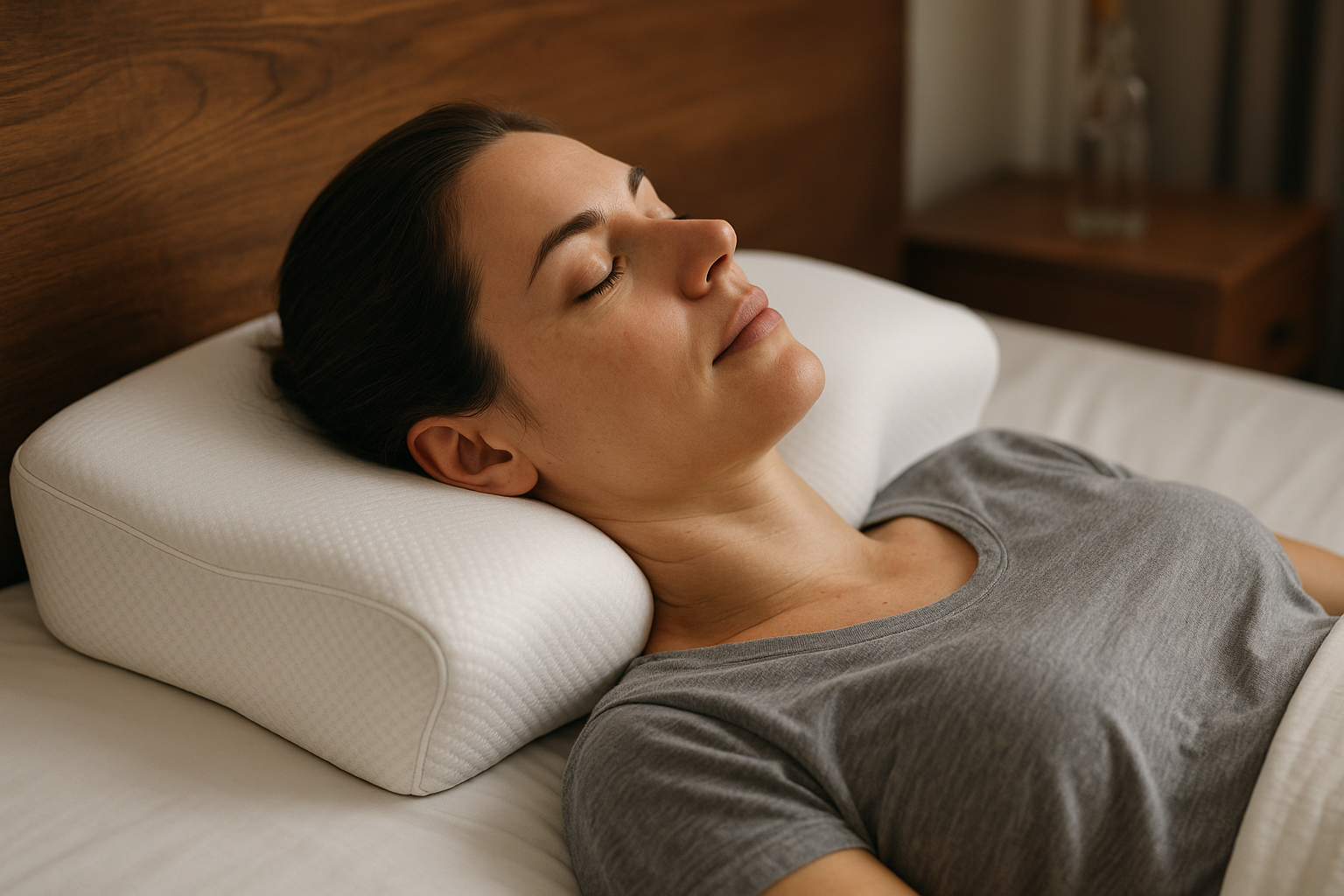
Waking up with a stiff neck, a dull headache, or shoulders that feel “stuck” is more common than many people think. Often, it’s not just yesterday’s screen time or a long day at the desk that’s to blame—it’s what happens while you sleep. When your head is positioned too high, too low, or tilted to one side for hours, the muscles around the neck and upper back may stay active instead of recovering. Over time, that can affect sleep quality and leave you feeling less rested, even after a full night in bed.
Good sleep is about more than comfort; it’s also about alignment. The neck (cervical spine) naturally has a gentle curve, and your pillow plays a key role in whether that curve is supported or flattened. If the pillow doesn’t match your body and sleep position, your neck may compensate—sometimes subtly, sometimes enough to notice first thing in the morning.
What is a contoured pillow?
A contoured pillow is shaped to follow the natural curve of the neck and head rather than staying uniformly flat. Most designs have a raised area that supports the neck and a lower center section where the head rests. You may also see two different “heights” on either side, allowing you to choose the side that best fits your build and preferred sleeping position.
This category has become increasingly popular because it speaks to a practical need: many sleepers want a pillow that feels more “guided,” especially if they switch between back and side sleeping or frequently wake up to readjust their pillow.
Why shape alone isn’t the whole story
It’s tempting to assume that any ergonomic-looking pillow automatically improves posture at night, but real-world comfort is usually a combination of shape, height, and material. A contoured pillow that’s too tall can push the head forward; one that’s too low may not provide enough support. The goal is a neutral position where the head feels cradled and the neck feels supported—without forcing you into a rigid posture.
What you’ll learn in this guide
In the rest of this post, we’ll break down how contoured pillows are designed, what to look for when choosing one, and how to use it correctly for your sleep style. You’ll also get practical guidance to help you set realistic expectations—so you can make a more informed choice for better, more comfortable sleep.
Anatomy and functionality of a contoured pillow
Most contoured pillow designs are built around one key idea: your head and neck don’t need the same height of support. The head is heavier and benefits from a stable “cradle,” while the neck needs a supportive rise that helps maintain its natural curve. That’s why many models combine a lower center area for the head with a raised neck roll that fills the space between the neck and the mattress.
You’ll often see two raised edges—one higher and one lower—so you can choose the loft that best matches your body size and sleep position. For many people, the higher side suits side sleeping (where the shoulder creates extra distance to the mattress), while the lower side feels better for back sleeping. The goal is not to lock you into one posture, but to reduce the amount of “searching” your body does at night to find support.
How the shape supports alignment
When the neck roll fits correctly, it helps keep the cervical spine closer to neutral. In practical terms, that means avoiding two common problems: the head tipping too far forward (which can shorten and tense the muscles at the base of the skull) or dropping too far back (which can strain the front of the neck). A well-fitted contour can also reduce the tendency to rotate the head to one side for long periods, which some sleepers do when their pillow collapses or shifts.
Material matters as much as contour
Contoured pillows are frequently made with memory foam because it molds under heat and pressure, distributing load across a larger surface area. That can help reduce pressure points around the ear, jaw, and side of the face for side sleepers, while still keeping the neck supported. Some foams feel slow-responding and “hugging,” while others are more responsive and spring back faster; both can work, but they feel very different in use.
Breathability is another consideration. Foam can retain warmth, so design features like ventilation channels, perforations, or breathable covers may improve temperature comfort. Durability also matters: a contoured pillow should hold its shape night after night. If the neck roll softens too quickly or the center compresses unevenly, the pillow can stop providing consistent support even if it still looks intact.
What the research suggests (and what it doesn’t)
Clinical research on pillow design points to an important takeaway: changing pillow type can influence neck and upper-back positioning, but a contoured shape alone does not guarantee better alignment for every person. Studies comparing different pillow materials and constructions show that the interaction between height, firmness, and shape is what ultimately affects how the head and neck settle during sleep. In other words, the “best” contoured pillow is the one that fits your anatomy and sleep position—not simply the one with the most dramatic curve.
Benefits of using a contoured pillow
Targeted neck and spine support
When your pillow supports the neck roll area appropriately, the muscles around the neck and shoulders may not need to work as hard to stabilize your head. Many people notice this as less morning stiffness, fewer “tight trap” sensations, or reduced discomfort when turning the head after waking. By spreading pressure more evenly, a contoured pillow can also feel more stable than a traditional pillow that bunches up or flattens during the night.

Men's Posture Shirt™ - Black
Posture shirt stimulates muscles & can relieve pain for everyday, work & sports use.
Improved sleep quality through fewer disruptions
Sleep quality isn’t only about falling asleep—it’s also about staying asleep. A pillow that keeps you comfortable can reduce the number of micro-adjustments you make overnight. If you frequently wake to fold your pillow, push it into place, or switch sides because your neck feels unsupported, a contoured pillow may help by providing a more consistent “landing spot” for your head and neck.

Women's Posture Shirt™ - Black
Stimulates muscles, relieves tension & improves posture; ideal for work & leisure use.
Who may benefit most
Contoured pillows are often a good match for people who spend long hours at a desk, since sustained screen time can contribute to neck and shoulder tension that becomes more noticeable at night. They’re also commonly chosen by individuals who experience recurring neck pain or stiffness, and by those recovering from minor strains who want more predictable support while sleeping. Side sleepers who struggle with the gap between shoulder and head may find contouring especially helpful—provided the pillow height matches their shoulder width and mattress firmness.
Choosing the right contoured pillow for your sleep position
Start with fit. For back sleeping, look for a contour that supports the neck without pushing the head forward; many people do best with a lower loft on the head cradle and a moderate neck roll. For side sleeping, you typically need more height to keep the nose and breastbone aligned and to prevent the head from tilting down toward the mattress. Stomach sleeping is the most challenging with contoured designs; if you sleep on your stomach often, consider a very low-profile option or a different pillow style to avoid excessive neck rotation.
Finally, pay attention to firmness and shape definition. A contoured pillow should have a clearly supportive neck roll, but it should still allow comfortable settling rather than forcing a rigid position. If possible, choose a pillow with multiple height options (or a reversible design) so you can fine-tune the fit instead of trying to “make it work” night after night.
How to get the most out of a contoured pillow
Even a well-designed contoured pillow can feel unfamiliar at first. Because it guides the head and neck into a more consistent position, it may highlight habits you have adapted to over time—like sleeping with your chin tucked or turning your head sharply to one side. A few practical adjustments can help you settle in and evaluate comfort more accurately.
Allow a realistic adjustment period
Many people need several nights to adapt when switching from a traditional pillow to a contoured pillow. During this period, focus on how your neck and shoulders feel in the morning rather than judging comfort in the first few minutes of lying down. If the pillow feels “too structured,” try using it for part of the night for the first few days, then gradually increase use as your body adapts.
It can also help to check your sleeping setup as a whole. Mattress firmness affects how far your shoulder sinks in (especially for side sleepers), which changes the height you need from the pillow. If your mattress is very soft, you may need less pillow height than you would on a firmer surface.
Dial in positioning for back and side sleeping
For back sleeping, the goal is to let the head rest in the central cradle while the neck roll supports the curve of the neck. Your chin should feel neutral—not tilted toward the chest and not angled upward. If you feel your head being pushed forward, you may be using the higher side, or the pillow may be too tall for your build.
For side sleeping, align your nose with the center of your chest to avoid the head tipping down or up. The neck roll should fill the space between the neck and mattress without lifting the shoulder. If you feel pressure on the ear or jaw, you may benefit from a slightly softer surface feel, a more breathable cover, or a contour that better matches your shoulder width.
Maintenance and care for long-term support
A contoured pillow works best when its shape stays consistent. Follow the care instructions for your specific model, but as a general rule, most foam cores should not be machine washed. Instead, use a removable cover that can be washed regularly to manage sweat and skin oils. If the pillow has an inner protector, keep it on to reduce wear on the foam.
Let the pillow air out occasionally, especially if you sleep warm. Avoid prolonged exposure to direct sunlight or high heat, which can degrade foam over time. If you notice the neck roll softening significantly or the head cradle developing an uneven “dip,” it may be a sign the pillow is no longer providing reliable support.
Common misconceptions about contoured pillows
One of the most common misunderstandings is that any contoured pillow automatically improves alignment. In reality, contouring is only one part of the equation. Height, firmness, and material responsiveness determine how your head and neck actually settle during sleep. A dramatic curve can look orthopedic but still be a poor match if it forces the head forward or leaves the neck unsupported.
Another misconception is that discomfort always means the pillow is “working.” While a short adjustment period is normal, persistent pain, numbness, or worsening headaches are not goals to push through. If symptoms increase over time, it may indicate the pillow’s height or firmness is not appropriate for your sleep position, or that you are spending more time in a position (such as stomach sleeping) that places the neck in sustained rotation.
Frequently Asked Questions
What is the difference between a contoured pillow and a cervical pillow?
The terms are often used interchangeably. In general, contoured pillow describes the shape (a head cradle with a raised neck roll), while cervical pillow describes the purpose (supporting the cervical spine). Many products fit both descriptions, so it is more useful to evaluate the pillow’s height, firmness, and contour definition than the label alone.
Can contoured pillows help with headaches?
They may help if headaches are related to neck tension or poor sleeping posture. By supporting a more neutral neck position, a contoured pillow can reduce strain in the muscles around the neck and base of the skull for some people. However, headaches have many causes, so persistent or severe symptoms should be assessed by a healthcare professional.
Are contoured pillows suitable for stomach sleepers?
Stomach sleeping typically requires a very low pillow to reduce neck rotation and extension. Many contoured designs are too high for this position. If you sleep on your stomach frequently, consider a low-profile option or a different pillow style, or work toward side sleeping for a more neutral neck position.
How long does it take to adjust to a contoured pillow?
Many people adapt within several nights, but it can take up to a couple of weeks to feel fully accustomed, especially if you are changing both pillow height and support style. A gradual transition—using the pillow for part of the night at first—can make the change easier.
What should I look for in a high-quality contoured pillow?
Look for a clearly supportive neck roll, appropriate height options (such as two loft sides or multiple sizes), durable materials that retain shape, and a breathable cover for temperature comfort. The best contoured pillow is the one that matches your body dimensions, mattress firmness, and primary sleep position, rather than the one with the most pronounced contour.
Källor
- Sidney Sleep. (n.d.). ”Are Contoured Pillows Better? A Comprehensive Guide.”
- Pillows Australia. (n.d.). ”How to Sleep on a Contoured Pillow Shape.”
- Leeford Ortho. (n.d.). ”Contoured Cervical Pillow vs. Regular Pillow: Which Helps More?”
- Rinipo. (n.d.). ”How Contour Pillows Assist in Sleeping in Perfect Alignment.”
- Somnuz. (n.d.). ”Contour Pillow Guide.”
- Good Housekeeping. (n.d.). ”Best Pillows for Neck Pain.”