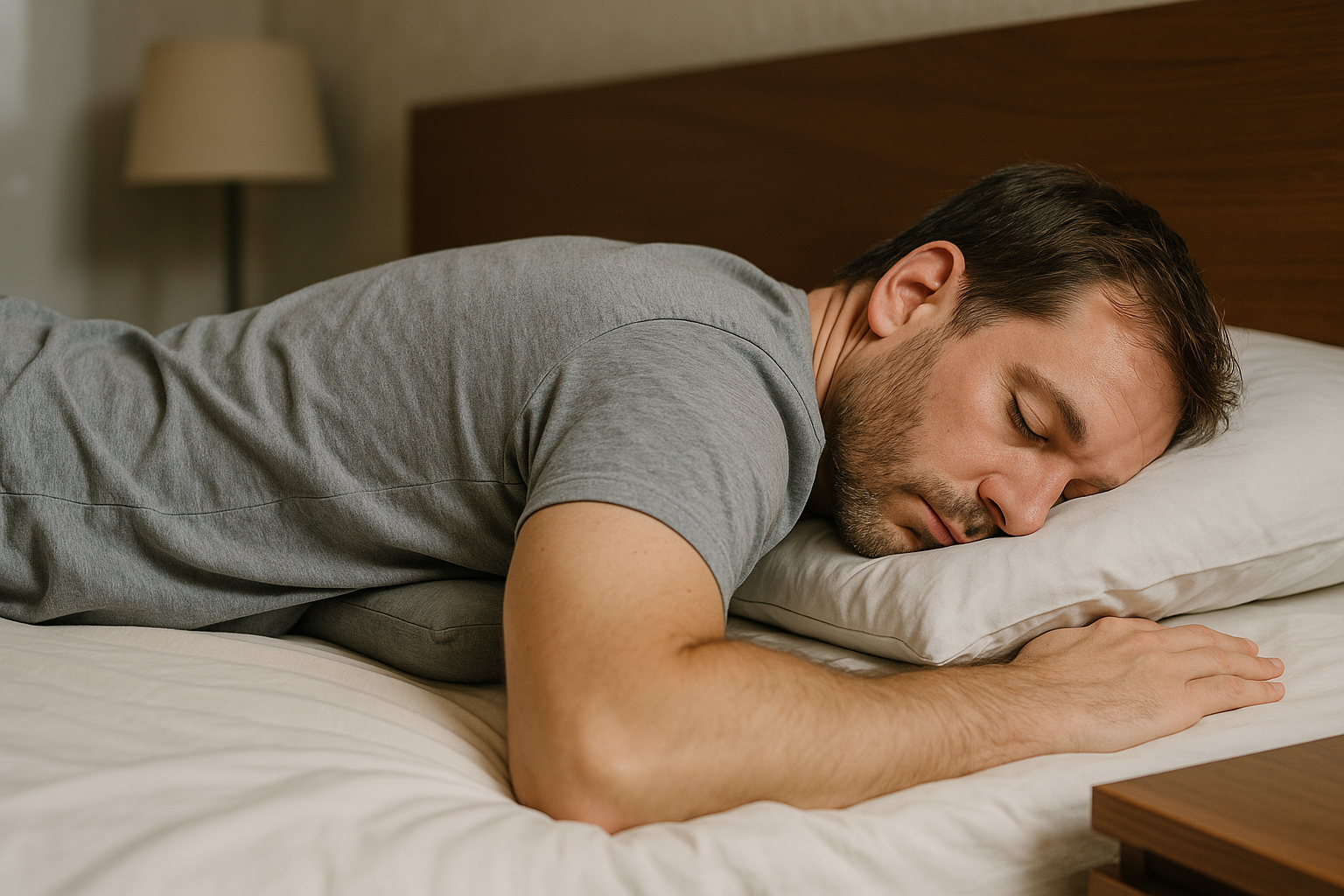
Some sleep habits feel so natural that we rarely question them. Sleeping on your stomach is one of them: you drift off face-down, often with one knee pulled up and your head turned to the side, and it simply works—until it doesn’t. This sleep posture is also known as the prone position, and while it’s not the most common choice, it’s far from rare. Roughly 16% of adults prefer it, which means millions wake up in the same position every day.
Sleep positions matter because your body spends hours in one sustained posture. That can be restorative when joints and muscles are supported, or it can quietly load the neck, shoulders, and lower back in ways you only notice once you’re up and moving. So the real question is: is sleeping on your stomach a hidden health risk or a misunderstood habit?
Why stomach sleeping gets so much attention
Most concerns come down to mechanics. To breathe, you typically have to rotate your head to one side. That twist can leave the neck in an end-range position for a long time, which may contribute to morning stiffness or a nagging, one-sided ache. At the same time, the chest and hips press into the mattress, and depending on your body shape and mattress feel, the lower back can end up slightly arched rather than neutral. For some people, that combination is the perfect recipe for waking up feeling “off” even after a full night’s sleep.
There’s also a practical reason people are curious: stomach sleeping can be hard to change. Many stomach sleepers describe it as their default, especially if they toss and turn or feel most secure with pressure on the front of the body.
Risks, benefits, and the personality question
The internet often labels stomach sleeping as the “worst” position, but the truth is more nuanced. Some people report fewer snoring issues in this posture, and a small group finds it helps them feel less congested or more open through the airway. Others notice the opposite: more tension in the neck and shoulders, numbness in an arm, or a tight lower back.
You may also see claims that stomach sleepers share certain personality traits—like being more impulsive or risk-tolerant. These ideas are interesting, but they’re largely speculative and not something you should use to judge your health or sleep quality.
Next, we’ll break down what sleeping on your stomach can do to your neck and spine, when it becomes a bigger issue (including pregnancy), and how to think about the trade-offs.
How sleeping on your stomach affects the neck and spine
The biggest issue with sleeping on your stomach is that breathing usually forces your head to rotate to one side. That means your neck stays in a twisted, end-range position for a long time. Over hours, the small joints in the cervical spine can become irritated, and the surrounding muscles (especially along the side of the neck and upper shoulder) may tighten to “hold” the position. The result is often morning stiffness, a one-sided ache, or a feeling that you can’t comfortably turn your head fully in one direction.
Your mid-back and lower back can also take a hit. When you lie face-down, the pelvis and ribcage press into the mattress. If the mattress allows your hips to sink more than your chest, the lower back may fall into an exaggerated curve. This can pull on the lumbar joints and compress tissues in the lower spine. If, on the other hand, the mattress is very firm and doesn’t accommodate your hip bones, you may feel pressure points and tension through the front of the hips, which can also tug on the lower back.
Arm placement matters too. Many stomach sleepers rest with one arm overhead or tucked under the pillow. Holding the shoulder in that lifted, rotated position for hours can contribute to shoulder irritation, tingling, or numbness down the arm, especially if nerves or blood vessels are compressed.

Lumbar support belt
Stabilizes and relieves your lower back, ideal for back pain and daily support.
When stomach sleeping becomes a bigger problem
Occasional nights on your stomach are not automatically harmful, but the risk tends to increase when symptoms become consistent. If you regularly wake with neck pain, headaches that start at the base of the skull, pins and needles in the arms, or a tight lower back that lingers into the day, your sleep posture may be part of the puzzle. The same is true if discomfort improves on nights you happen to fall asleep on your side or back.
It can also become more problematic if you already have a sensitive neck, a history of disc issues, or recurring shoulder pain. In these cases, the combination of neck rotation plus pressure through the chest and hips can be enough to keep tissues irritated, even if you feel fine while falling asleep.
Pregnancy and sleeping on your stomach
During pregnancy, sleeping on your stomach is generally discouraged as the body changes. Early on, some people can still tolerate it, but as the abdomen grows it becomes uncomfortable and can place pressure where you don’t want it. Many are advised to transition toward side sleeping, often with a preference for the left side because it can feel easier for circulation and may reduce heartburn for some.
Just as important: pregnancy can increase general joint laxity and change spinal loading, so a position that previously felt “fine” may suddenly trigger hip, pelvic, or low-back discomfort. If you’re pregnant and unsure what’s best for you, it’s sensible to discuss sleep positioning with a midwife or healthcare professional, especially if pain or numbness is showing up at night.
Benefits: why some people still prefer it
Despite the downsides, sleeping on your stomach can have a few potential upsides. Because the body is face-down, the airway mechanics may change in a way that reduces snoring for some people. A prone posture can also lessen how easily the tongue and soft tissues fall backward, which is why some individuals feel their breathing is more open in this position. That said, suspected sleep apnea should be assessed by a clinician; changing sleep position may help symptoms, but it doesn’t replace proper evaluation.
Some people also report that stomach sleeping feels better for reflux. Individual responses vary, and for many, side sleeping is the more commonly recommended approach for heartburn. Still, if you notice clear patterns—less reflux on your stomach and more on your back, for example—that information can help you make more informed choices and adjustments.
Drawbacks beyond pain: skin pressure, numbness, and stiffness
Stomach sleeping increases direct pressure on the face because the cheek and forehead are often pressed into the pillow. Over time, that can contribute to sleep lines and skin irritation, particularly if you’re prone to breakouts or have sensitive skin. It can also irritate the eyes in some individuals due to pressure around the orbit.
Another common complaint is waking with a “dead arm” or tingling hand. This is often a sign of prolonged compression at the shoulder, elbow, or wrist, or a stretched nerve pathway from the neck into the arm. Similarly, stiffness through the chest, hip flexors, and front of the shoulders can build up because these areas are held shortened for hours.
Personality traits: interesting, but not a health tool
You’ll often see claims that stomach sleepers are more impulsive, risk-tolerant, or anxious. These ideas are popular because they’re relatable and fun to read, but the scientific support is limited and the findings are not consistent enough to guide health decisions. If you sleep on your stomach, the most useful “signal” isn’t a personality label—it’s how your body feels in the morning and whether you’re getting restorative, pain-free sleep.
How to make sleeping on your stomach more comfortable
If sleeping on your stomach is your default, the goal is not perfection—it is reducing strain. Small adjustments can lower the load on your neck, shoulders, and lower back without forcing you to change everything overnight. Start by paying attention to what feels stiff or sore in the morning, then use that feedback to fine-tune your setup.
Pillow and mattress setup for better alignment
The neck is often the first area to complain because the head must turn to the side to breathe. A high pillow can increase the twist by lifting the head and adding side-bending. Many stomach sleepers do better with a very low, soft pillow, or even no pillow, so the neck stays closer to neutral. If you prefer having something under your head, choose a pillow that compresses easily rather than one that holds height.
Mattress feel matters because it influences what your lower back does for hours at a time. If your mattress is very soft and your hips sink deeply, your lower back may arch more than it should. If it is extremely firm, you may feel pressure at the hip bones and ribs, which can also create tension. A balanced surface that supports the pelvis without letting it drop too far tends to be the most forgiving. If replacing a mattress is not realistic, a mattress topper can be a practical way to adjust comfort and support.
Body position tweaks that reduce torque
Stomach sleeping often becomes uncomfortable because the body is twisted: head turned, one knee pulled up, one arm overhead. You can reduce that spiral by making a few changes:
- Keep the arms lower: Instead of sleeping with an arm overhead, try placing both arms down by your sides or in a lower “goalpost” position to reduce shoulder strain.
- Use a small pillow under the pelvis: A thin cushion or folded towel under the lower abdomen/hips can decrease the arch in the lower back for some people.
- Choose a consistent head turn: If you always rotate to the same side, you may overload one side of the neck. Alternating sides can help distribute strain, as long as it does not disrupt sleep.
- Unwind the hips: If one knee is always pulled up, try lowering it slightly or placing a small pillow under the shin to reduce hip rotation.
Morning mobility to offset overnight stiffness
Even with good support, sleeping on your stomach can leave the front of the body feeling tight. A short morning routine can help restore range of motion. Gentle movements are usually more useful than aggressive stretching right after waking.
Try 30–60 seconds of child’s pose to open the lower back, followed by a slow chest-opening stretch (hands clasped behind the back while standing, if comfortable). If your neck feels stiff, use controlled head turns left and right within a pain-free range rather than forcing a deep stretch.

Women's Posture Shirt™ - Black
Activates muscles to boost posture and relieve pain in neck, back, and shoulders.
How to transition away from stomach sleeping
If you regularly wake with neck pain, headaches, numbness, or lingering back discomfort, transitioning to side sleeping is often the most effective long-term change. The easiest approach is gradual. Start by falling asleep on your side with a body pillow in front of you so you can rest your top knee and arm on it. This reduces the urge to roll forward onto your stomach. Some people also benefit from placing a pillow behind the back as a “bumper” to make rolling over less automatic.
Expect a learning period. Your nervous system is used to one position, and changing it can temporarily affect sleep quality. Aim for progress rather than immediate success, and focus on what improves symptoms over time.
Frequently Asked Questions
Is sleeping on your stomach bad for your health?
Sleeping on your stomach is not automatically harmful, but it is more likely to irritate the neck and lower back because the head is rotated and the spine can fall out of neutral alignment. Some people experience benefits such as reduced snoring, but if you consistently wake with pain, stiffness, or numbness, it is a sign the position may not be working well for your body.
Can sleeping on your stomach cause neck pain?
Yes. When sleeping on your stomach, you typically turn your head to one side to breathe. Holding the neck in that rotated position for hours can strain muscles and irritate joints, leading to morning stiffness, one-sided soreness, or headaches that start near the base of the skull.
What is the best sleep position for pregnant women?
Side sleeping is generally recommended during pregnancy, often with a preference for the left side because it can feel more comfortable for circulation and may reduce heartburn for some people. Stomach sleeping usually becomes uncomfortable as the abdomen grows. Individual needs vary, so it is sensible to discuss sleep positioning with a midwife or healthcare professional if pain or numbness is present.
Are there any ergonomic aids to help stomach sleepers?
Helpful options include a very low pillow (or no pillow) to reduce neck strain, a thin pillow or towel under the pelvis to reduce lower-back arching, and a mattress topper to fine-tune firmness and pressure relief. If you are trying to switch positions, a body pillow can make side sleeping feel more stable and natural.
How can I stop sleeping on your stomach?
Start by changing how you fall asleep: lie on your side with a body pillow in front of you and, if needed, a pillow behind your back to limit rolling. Keep the setup consistent for a few weeks so your body learns the new default. If pain is persistent or worsening, consider getting individual guidance from a healthcare professional.
Kilder
- Healthline. (2023). "Is It Bad to Sleep on Your Stomach?"
- Sleep Foundation. (2023). "Sleeping on Your Stomach."
- Cleveland Clinic. (2023). "Sleeping on Your Stomach: Pros and Cons."
- The Sleep Chapter. (2023). "Sleeping on Your Stomach: Is It Bad for You?"
- Mattress Nerd. (2023). "How to Sleep on Your Stomach Comfortably."
- Nectar Sleep. (2023). "Stomach Sleeper: Good or Bad?"
- Parkland Medical Center. (2023). "How a Good Night's Sleep Benefits Your Digestion."