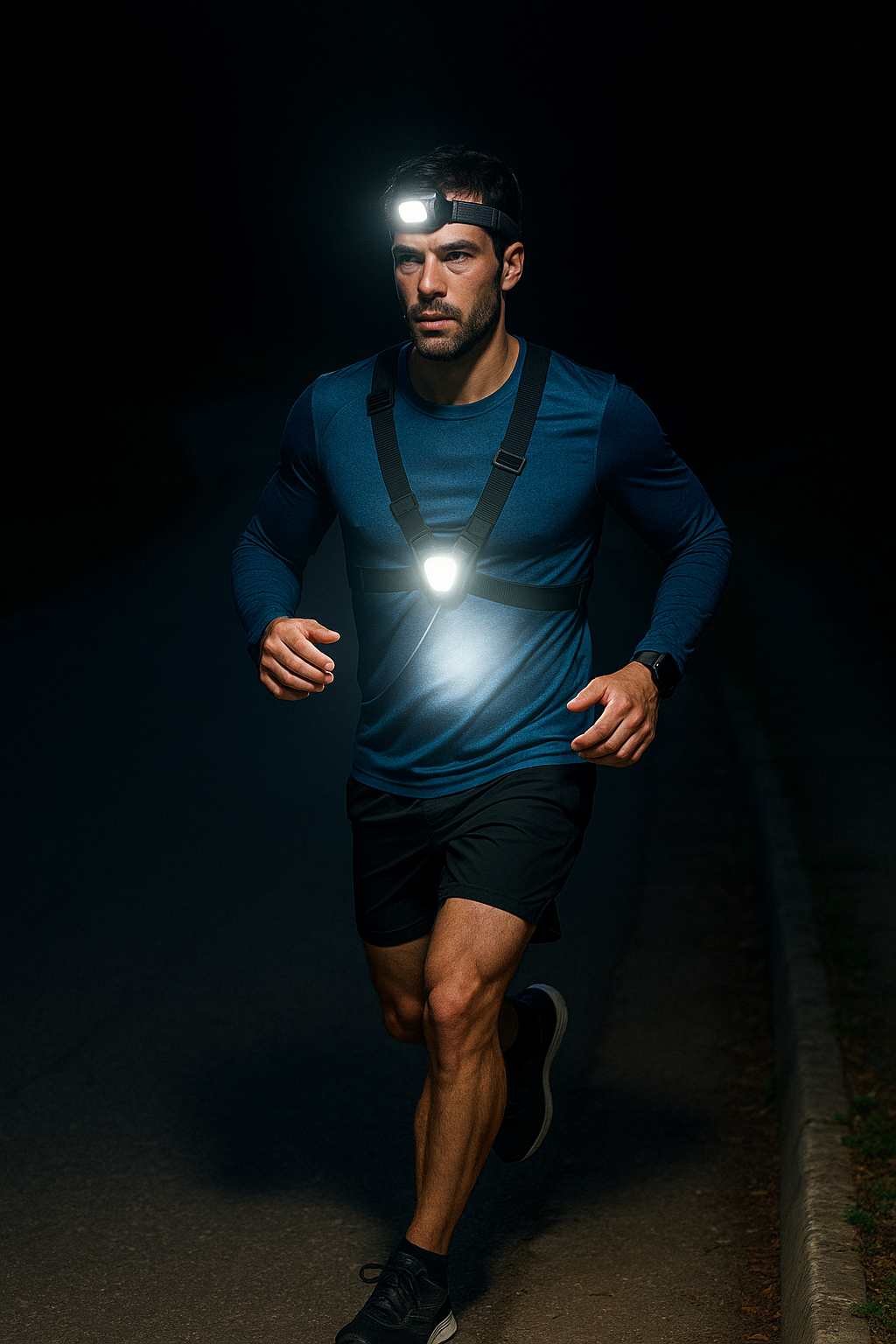


Running doesn’t have to be limited to daylight. With the right headlamp for running, early mornings, dark winter evenings, and shaded trails become realistic training windows instead of obstacles. Good light helps you see the surface ahead, spot uneven pavement or roots in time, and stay visible to drivers, cyclists, and other runners. In other words: it’s not just about brightness, it’s about confidence and control when your surroundings are harder to read.
Many runners try a basic headlamp once, get annoyed by bouncing, short battery life, or a beam that’s either too weak or uncomfortably harsh, and then give up. But a running-specific setup can feel surprisingly “invisible” when it fits well—steady on the head, easy to adjust mid-run, and bright enough at the settings you actually use (not only on the highest mode).
Why a headlamp for running changes your safety
Low light increases the chance of missteps: potholes blend into asphalt, wet leaves hide curbs, and trail texture disappears. A headlamp improves your ability to react, which can reduce the risk of trips and awkward landings. It also helps with being seen: a moving light source on your body is easier for others to notice than dark clothing alone, especially at crossings and on shared paths.
What to look for before you buy
The best headlamp for running is the one that matches your route and feels stable on your body. Start with four practical criteria:
- Brightness and beam: for many road runs, moderate light is enough, while trails typically demand more reach and wider spill to read the terrain.
- Battery life: look for realistic runtime on medium settings and convenient charging (USB-C is a common preference) so you’re not rationing light on longer sessions.
- Comfort and bounce control: lighter units and well-designed straps reduce movement and pressure points, especially over longer distances.
- Safety features: reflective details, rear visibility, and strobe modes can matter as much as raw lumens when you run near traffic.
Choosing the right fit matters for posture
Ergonomics is often overlooked in headlamp guides, but it matters. A poorly balanced lamp can encourage you to tilt your head down to “chase” the beam, adding tension through the neck and upper back. The right fit keeps the beam where you need it with a neutral head position—so you can run tall, relaxed, and focused, even when the light is doing the hard work.

Men's Posture Shirt™ - Black
Activates muscles and improves posture for relief, comfort, and performance in everyday and active use.
Understanding headlamp features for running
It’s easy to get pulled into “max lumens” marketing, but the best headlamp for running is the one that gives you usable light, stable fit, and predictable runtime on the settings you’ll actually use. Think of the specs as a system: brightness and beam shape determine what you can see, battery determines how long you can keep seeing it, and comfort determines whether you’ll still want to wear it after 30 minutes.
Brightness and beam patterns
Lumens describe the total amount of light a headlamp can emit, but they don’t tell the whole story. Lens design, beam focus, and the angle you aim the lamp all affect how bright the ground looks in front of you. As a practical baseline, around 200 lumens is often sufficient for road running and well-lit paths, especially if your goal is to see surface changes and be seen. For trail running, higher output is typically more comfortable because you’re reading texture, depth, and obstacles at speed. Many runners prefer a headlamp that can reach 400–800+ lumens for technical terrain, while still offering efficient medium modes for longer sessions.
Beam pattern matters just as much as raw brightness:
- Spot beam: a tighter, longer-reaching beam that helps you look farther down the path. Useful when you’re moving fast or scanning ahead on trails, but it can feel “tunnel-like” if it’s too narrow.
- Flood beam: a wider beam that lights up the area closer to you and improves peripheral awareness. Great for roads, gravel paths, and smoother trails where you want comfortable, even light.
- Mixed beam: combines spot and flood so you can see both near and far. This is often the most natural-feeling option for runners because it supports quick foot placement without sacrificing distance visibility.
If you run in groups or on shared paths, a headlamp with multiple modes helps you reduce glare for others while still keeping enough light to run safely.
Battery life and charging options
Battery life should be evaluated in terms of runtime at medium output, not just the shortest “turbo” number. A headlamp for running that lasts two hours only on its lowest setting can become frustrating quickly, especially in winter when cold temperatures can reduce battery performance.
For most runners, a USB-C rechargeable headlamp is the simplest option: it’s easy to top up after work, it reduces disposable battery waste, and it’s convenient for travel. If you regularly run long distances, consider whether the lamp supports:
- Swappable batteries: useful for ultras or back-to-back long runs where charging time is limited.
- Lockout modes: prevent accidental activation in a bag, which can drain the battery before your run.
- Clear battery indicators: so you can make smart decisions about mode selection before you’re far from home.
A good rule of thumb is to choose a lamp that can comfortably cover your longest planned run with a buffer, so you’re not forced to dim the light right when fatigue makes footing less precise.
Comfort, weight, and fit
Comfort is performance. A headlamp that bounces, squeezes, or slowly slips will pull your attention away from your stride and can encourage subtle posture changes, like tightening the neck or clenching the jaw. For many runners, a lightweight unit (often under about 100 g on the head) feels noticeably easier to forget you’re wearing.
To reduce bounce and pressure points, look for:
- Adjustable headbands with a secure, non-slip feel that doesn’t require over-tightening.
- Top straps (on some models) that improve stability for faster running or rough terrain.
- Low-profile designs that sit close to the forehead to reduce “lever effect” movement.
Fit tip: tighten the band just enough that the lamp doesn’t shift when you gently shake your head. If you need to crank it down to stop bounce, the lamp may be too heavy for your preferred running style, or the headband design may not match your head shape.
Choosing a headlamp for running by scenario
Road running
Road running usually rewards a lighter, simpler setup. Prioritise a stable fit, comfortable flood or mixed beam, and features that help others see you. A rear light or strobe mode can be valuable near traffic, and quick-access controls make it easier to adjust brightness at crossings or under streetlights. The BioLite Dash 450 is often highlighted for road running thanks to its comfortable fit and strong illumination in a compact package.
Trail and ultra running
On trails, you’re managing uneven surfaces, changing grades, and more visual complexity. Higher lumens, a mixed beam, and dependable runtime become more important, along with water resistance for rain and wet conditions. For runners who want serious brightness and durability, the Fenix HM65R-T V2.0 is frequently mentioned as a strong option for demanding terrain and long efforts.
General outdoor use
If you want one light for running, walking, and travel, versatility matters. Multiple brightness levels, efficient medium modes, and a comfortable band can cover most needs without overcomplicating your kit. The Nitecore NU27 stands out for offering a wide range of modes and useful light options, making it a practical choice when your activities vary week to week.
Ergonomics with a headlamp for running
A headlamp for running should support your stride, not change it. When the lamp is heavy, sits far from the forehead, or is poorly balanced, it can create a subtle “pull” that encourages you to tilt your head down to keep the beam where you want it. Over time, that small adjustment can increase tension through the neck, shoulders, and upper back—especially on longer runs when fatigue makes posture harder to maintain.
Two factors matter most: weight and balance. A lighter unit generally feels more stable and requires less strap tension, which can reduce pressure points on the forehead. Balance matters because a front-heavy lamp acts like a lever: every foot strike can amplify bounce, and the body often compensates by tightening the neck. If you notice yourself “chasing the light,” try a different setup before assuming you need more lumens.

Women's Posture Shirt™ - Black
Activates muscles and improves posture, reducing pain and tension for better performance and daily comfort.
How to set the beam angle without straining your neck
A simple posture-friendly approach is to aim the beam so it lands a few metres ahead on flat ground at your normal pace. If the hotspot is too close to your feet, you’ll tend to look down; if it’s too far ahead, you may miss small surface changes. On trails, you can angle slightly lower for foot placement, then raise it on climbs or when scanning for turns. The goal is to keep your head stacked over your torso as much as possible, with the lamp doing the work.
Headlamp vs waist light vs chest light
Not every runner needs the same lighting format. If you have recurring neck or shoulder tightness, or you simply dislike anything on your head, alternatives can be worth considering.
- Headlamp: best for looking where you turn your head (useful on winding trails) and for hands-free convenience. The downside is that all weight and pressure sit on the head, and bounce can be noticeable if the fit is off.
- Waist light: often feels more comfortable for long sessions because it removes weight from the head. Because the light source is lower, shadows can improve depth perception on uneven ground, making rocks and roots easier to “read.” The trade-off is that the beam follows your torso rather than your gaze, so quick head turns don’t automatically redirect light.
- Chest light: can be a good middle ground for stability and comfort, especially in cold weather when layers make headbands feel restrictive. It is typically stable, but you need to ensure it doesn’t bounce with breathing or sit too high and glare off jackets.
If you are prone to headaches from headband pressure, start by loosening the band slightly and choosing a lower-profile lamp. If that still feels distracting, a waist light can be a practical ergonomic switch—particularly for road running and smoother trails.
Safety and etiquette when running in the dark
Good lighting is not only about seeing; it is also about sharing space responsibly. On busy paths, angle your headlamp for running slightly downward to avoid shining directly into other runners’ or cyclists’ eyes. If you stop to talk, look down or switch to a lower mode to reduce glare. In group runs, a red mode can be useful when you are close together, but ensure you still have enough white light to see the surface when you start moving again.
Near traffic, visibility should be treated as a system: use your headlamp, but also consider reflective elements and, if available, a rear light or strobe mode. Flashing modes can increase attention from drivers, but in crowded areas a steady beam is often more comfortable for everyone around you.
Injury prevention with proper lighting
Adequate light helps you spot hazards early, which can reduce sudden braking steps and awkward landings. It also supports more consistent cadence because you can trust the surface ahead. In colder, darker conditions, include a slightly longer warm-up than you would in daylight, since stiff ankles and hips combined with poor visibility can increase the risk of missteps. After the run, a short cool-down walk helps you transition safely back to low light and reduces the chance of rushing through uneven areas while fatigued.
Frequently Asked Questions
What is the ideal lumen range for a headlamp for running?
For many road runs and well-lit paths, around 200 lumens is often sufficient. For darker routes, faster paces, and trail running where you need to read texture and obstacles, many runners prefer a lamp that can reach 400–800+ lumens, while still offering efficient medium modes for longer runtime.
How do you choose between a headlamp and a waist light?
Choose a headlamp if you want light that follows your gaze and you run on routes with frequent turns or technical navigation. Choose a waist light if you want to reduce head/neck load, improve comfort on long runs, or benefit from stronger ground shadows that can make uneven terrain easier to judge.
What should I consider for long-distance running with a headlamp for running?
Prioritise runtime on medium settings, a clear battery indicator, and a fit that stays stable without over-tightening. For very long runs, swappable batteries or the ability to carry a backup power source can prevent you from being forced into dim modes late in the session.
How do I maintain my headlamp for optimal performance?
Wipe the lens and housing after wet or muddy runs, and let the headband dry fully to reduce odour and material wear. Recharge before storage (and top up periodically if you do not use it often), and use any lockout function to prevent accidental activation in a bag. Store it somewhere dry and avoid leaving it in extreme heat or cold for long periods.
Källor
- Princeton Tec. (2023). "This is a Title of My Wonderful Post."
- Runner's World. (2018). "Best Headlamps for Runners."
- TrailSense. (2023). "Choose a Headlamp for Trail Running."
- Trail & Kale. (2023). "Best Running Headlamps for Hiking and Camping."
- BudgetLightForum. (2023). "Headlamp for Running."
- Treeline Review. (2023). "Best Running Lights."
- Relentless Forward Commotion. (2023). "Headlamp for Trail and Ultra Running."
- Knog. (2023). "Running Headlamps Collection."
- iRunFar. (2023). "Best Running Headlamp."
- Backpacking Light. (2023). "Headlamp Discussion for Running."