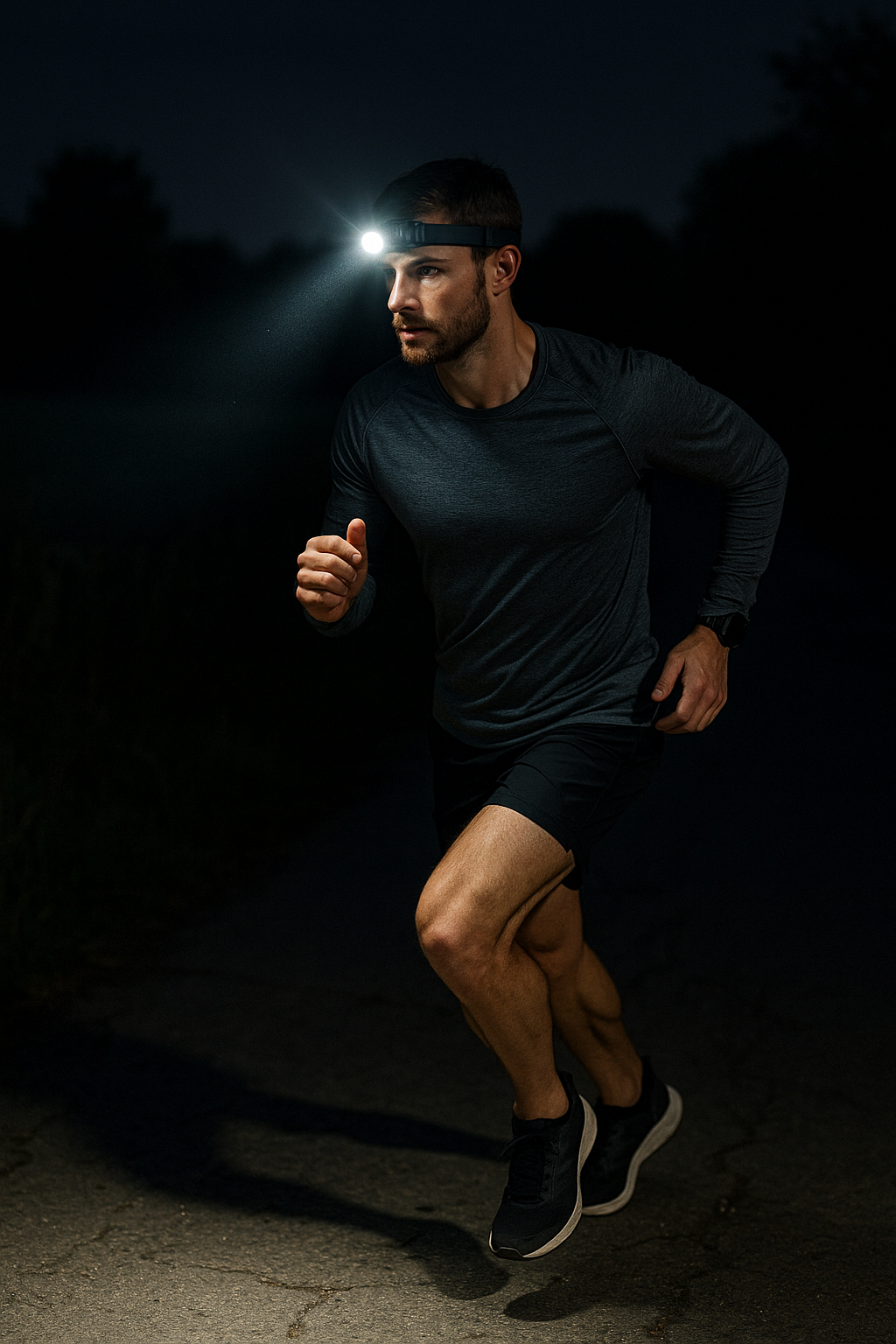
Night running can feel like the best kind of freedom: quieter streets, cooler air, fewer distractions. But once daylight disappears, your run changes. The right lights for running aren’t just a nice add-on—they’re what makes it possible to move naturally, react quickly, and stay predictable to everyone sharing the space with you.
There are two jobs your lighting setup needs to do at the same time: help you see what’s ahead and help others see you. Illumination is what reveals potholes, ice patches, roots, curbs, and uneven pavement before they turn into a sudden sidestep. Visibility is what tells drivers, cyclists, and other runners where you are and how you’re moving. Relying on only one of these is where people get caught out—especially on darker roads, mixed-use paths, or when weather reduces contrast.
Why good lighting changes how you run
When you can’t clearly read the ground, most runners instinctively tighten up: shorter steps, stiffer ankles, and a cautious posture that can creep into the shoulders and neck. Over time, that “braced” style can make an easy run feel harder than it should. With adequate lighting, you’re more likely to keep a smooth rhythm, place your feet confidently, and avoid last-second corrections that stress joints and soft tissue. In other words, smart lighting supports both safety and performance—without needing to run slower than you want to.

Men's Posture Shirt™ - Black
Activates your muscles and can relieve pain; for posture and comfort during daily life or activity.
Common challenges on night runs
Not all darkness is the same. A well-lit city route may only require modest illumination, while an unlit bike path or park loop can demand a stronger beam and better coverage. Trails add another layer: rocks, roots, and quick changes in elevation mean you need to see texture and depth, not just a bright spot in front of you.
Weather matters too. Rain can create glare on asphalt, fog can bounce light back into your eyes, and snow can make everything look flat and deceptively smooth. And if you’re out for longer, comfort becomes a real factor: too much brightness can feel harsh, while a poorly balanced light can bounce, distract, or create tension as you adjust it mid-run.
In the next section, we’ll break down the main types of running lights, how to match brightness to terrain, and which practical features make the biggest difference when you’re actually moving.
Types of running lights and when to use them
Different lights for running solve different problems, and the best setup often combines more than one. A strong “seeing” light helps you read the ground, while smaller “be seen” lights help you stand out in traffic or on shared paths.
Headlamps
A headlamp is the classic choice because it follows your gaze. When you look around a corner, scan for a curb, or pick a line on a trail, the beam moves with you. That makes headlamps especially useful on uneven terrain, where you need to spot texture changes, roots, and dips before your foot lands.
The trade-off is comfort and stability. If the lamp is heavy or sits high on the forehead, it can bounce and feel distracting. Over longer runs, some runners also notice neck or shoulder tension from the weight and from repeatedly adjusting the fit. A wide, stable headband and a lamp that sits close to the head usually feels better than a bulky unit that sticks out.
Chest and waist lights
Chest and waist lights place the beam lower and more centrally, which many runners find more natural. Because the light is anchored to your torso, it tends to bounce less than a headlamp and can feel more stable at faster paces. Another advantage is depth perception: a lower beam angle can cast shadows across bumps and cracks, making surface details easier to read.
The downside is that fit matters. A chest strap that’s too tight can feel restrictive, while a loose waist belt can slide or rotate. If you run in layers during colder months, you’ll also want a setup that’s easy to adjust without stopping.
Clip-ons and shoe lights
Clip-on lights, armbands, and shoe lights are primarily about visibility to others. They’re excellent for adding movement cues—especially on shoes—so drivers and cyclists can quickly recognize you as a runner. They’re also easy to place on a jacket, hydration vest, or waistband.
However, these smaller lights rarely provide enough forward illumination on their own. Think of them as supporting lights: great for being noticed, but not a replacement for a main beam when the route is dark or uneven.
How bright should lights for running be?
Brightness is measured in lumens, but the “right” number depends on how much ambient light you have, how technical the surface is, and how fast you plan to run. More lumens can help, but it can also add weight and drain the battery faster, so it’s worth matching output to your real conditions.
- Smooth roads with streetlights: around 100–200 lumens is often enough to spot basic hazards and stay comfortable.
- Unlit roads and dark bike paths: aim for 200 lumens or more so you can see further ahead and react earlier.
- Technical trails: 300–500 lumens is a common sweet spot for reading terrain. For very rough trails or faster descending, some runners prefer up to 1000 lumens, accepting the extra weight and shorter runtime.
Beam pattern matters as much as raw brightness. A wide flood beam helps you see near-field details and edges of the path, while a focused spot beam helps you look further ahead. If your light offers both (or a blend), you can adapt to roads, turns, and trail sections without constantly changing gear.
Battery choices and runtime planning
For most runners, the best light is the lightest one that can hold the brightness you need for the time you’ll be out. That’s where battery choice becomes practical, not just technical.
- Rechargeable lights: convenient for regular training runs, typically lighter for the same performance, and easy to top up. They’re ideal when you can charge between sessions.
- Disposable batteries (often lithium): useful for very long outings, cold conditions, or when you want quick swaps instead of waiting to recharge. They can also be a reliable backup option for races or travel.
Look for a battery indicator so you’re not guessing mid-run. If your light has multiple modes, consider using a lower setting on lit sections and saving higher output for truly dark or technical parts of the route.
Weather resistance and durability that actually matters
Night runs often come with rain, sweat, fog, and winter moisture. A light that fails in bad weather isn’t just inconvenient—it changes your ability to move safely. For regular outdoor use, an IPX4 rating or higher is a good baseline for resistance to rain and sweat. If you frequently run in heavy rain, slush, or wet trails, a higher rating can add confidence.
Also pay attention to usability in real conditions: buttons that work with gloves, a tilt mechanism you can adjust quickly, and a mount that stays stable when your clothing gets wet. These details are what keep your lighting consistent—so you can keep your stride relaxed and your attention on the run, not on your gear.
Comfort and ergonomics when using lights for running
Once you have the basics covered—brightness, battery, and weather resistance—the next step is making sure your lights for running feel good on your body. Comfort matters because discomfort changes how you move. If a headlamp bounces, a belt rotates, or a strap feels restrictive, you will often compensate without noticing: lifting the shoulders, tightening the neck, shortening the stride, or looking down too much. Over time, those small adjustments can add fatigue and increase the chance of a misstep.
Good lighting supports a more natural running form because you can keep your gaze forward and your posture tall. When the ground is clearly visible, you are less likely to “brace” through the ankles and hips, and you can avoid sudden last-second corrections that load the knees and lower back. In practical terms, the right setup helps you run smoothly, not cautiously.

Women's Posture Shirt™ - Black
Activates muscles and helps relieve tension; supports postural awareness for active and everyday use.
Headlamp comfort: weight, balance, and pressure points
With headlamps, the most common comfort issue is weight distribution. A lamp that sits far from the forehead can feel heavier than it is, especially over longer runs, because it creates more leverage with each step. Look for a design that sits close to the head, with a headband that spreads pressure evenly rather than creating a hotspot above the eyebrows.
Small adjustments make a big difference: tighten enough to prevent bounce, but not so much that you feel pressure or a headache. A tilt mechanism is also important for comfort and form. If you can angle the beam slightly downward, you can avoid craning your neck to “aim” the light at the ground.
Chest and waist lights: stable beam without restricting movement
Chest and waist lights often feel more stable at speed because the beam is anchored to the torso. The lower angle can also improve depth perception by casting shadows across cracks and uneven surfaces. For comfort, prioritize straps or belts that stay in place without compressing your breathing. If you wear layers in winter, choose a setup that is easy to adjust quickly and does not slip on smooth jacket fabrics.
A useful approach for many runners is a two-light system: a chest or waist light for consistent ground illumination, plus a small clip-on light (or reflective elements) to increase visibility from the side and rear.
How light placement can influence posture
Light placement affects where you look. A beam that is too narrow or aimed too close can encourage you to stare down, which tends to round the upper back and tighten the neck. A wider beam or a slightly longer throw helps you keep your eyes up and scan ahead, which supports a more relaxed, efficient posture. If you already pay attention to alignment through training habits or supportive apparel, stable lighting can help you maintain that same posture when conditions are dark.
Quick comparison: choose lights for running by scenario
| Running scenario | Suggested lumens | Best mounting option | Notes |
|---|---|---|---|
| City roads with streetlights | 100–200 | Clip-on + small headlamp or waist light | Prioritize being seen; avoid overly bright glare. |
| Unlit roads and bike paths | 200+ | Headlamp or chest/waist light | Choose a stable beam and a reliable runtime. |
| Technical trails | 300–500 (up to 1000 for fast/rough terrain) | Headlamp (often best) or headlamp + waist light | Wide + focused beam options help on varied terrain. |
| Long winter runs in wet conditions | 200–500 | Chest/waist light + backup clip-on | Look for IPX4+ and glove-friendly controls. |
A simple decision tree
- Is your route mostly lit? If yes, start with 100–200 lumens and add clip-on visibility lights.
- Is the route unlit or mixed? Choose 200+ lumens with a stable mount (headlamp or waist/chest).
- Is the surface technical (roots, rocks, uneven trail)? Move to 300–500 lumens and prioritize beam quality and tilt control.
- Are you running longer than your light’s rated runtime? Bring a backup light or choose a model with swappable batteries.
Frequently Asked Questions
Can I use a normal flashlight for running?
You can, but it is rarely ideal. A handheld flashlight ties up one arm, can alter arm swing, and often produces a beam that bounces unpredictably with each step. Body-mounted lights for running usually provide more consistent illumination and let you keep a natural rhythm.
Is 200 lumens enough for running?
Often, yes—especially for unlit roads, bike paths, and smoother surfaces where you mainly need to see hazards early. If you run fast, the route is very dark, or the terrain is uneven, you may prefer more output (or a better beam pattern) to extend your reaction time.
What is the best light for trail running at night?
For trails, a stable headlamp is typically the most practical choice because it follows your gaze. Aim for roughly 300–500 lumens for most technical terrain, and consider higher output for fast descending or very rough trails. A wide beam for near-field detail plus a focused beam for distance is especially useful.
Where should I wear my running light?
Use a main light (headlamp or chest/waist light) to illuminate the ground, and add smaller lights or reflective elements to improve visibility from multiple angles. Many runners find a waist or chest light comfortable for steady illumination, while clip-ons help drivers and cyclists recognize your movement.
How does light placement affect my running posture?
If your light forces you to look down to see clearly, it can encourage a rounded upper back and neck tension. A stable mount, a wider beam, and a correctly angled tilt help you keep your gaze forward and your posture more relaxed, which supports smoother foot placement and fewer sudden corrections.
Källor
- KBB Editors. (2023). "Daytime Running Lights." Kelley Blue Book.
- NC Nielsen. (2023). "Lys øger din sikkerhed." NC Nielsen.
- Public Lands. (2023). "How to Choose the Right Running Lights." Public Lands.
- Educated Guesswork. (2023). "Running Lights." Educated Guesswork.
- Runner's World Editors. (2023). "Best Running Lights." Runner's World.
- Treeline Review. (2023). "Best Running Lights." Treeline Review.