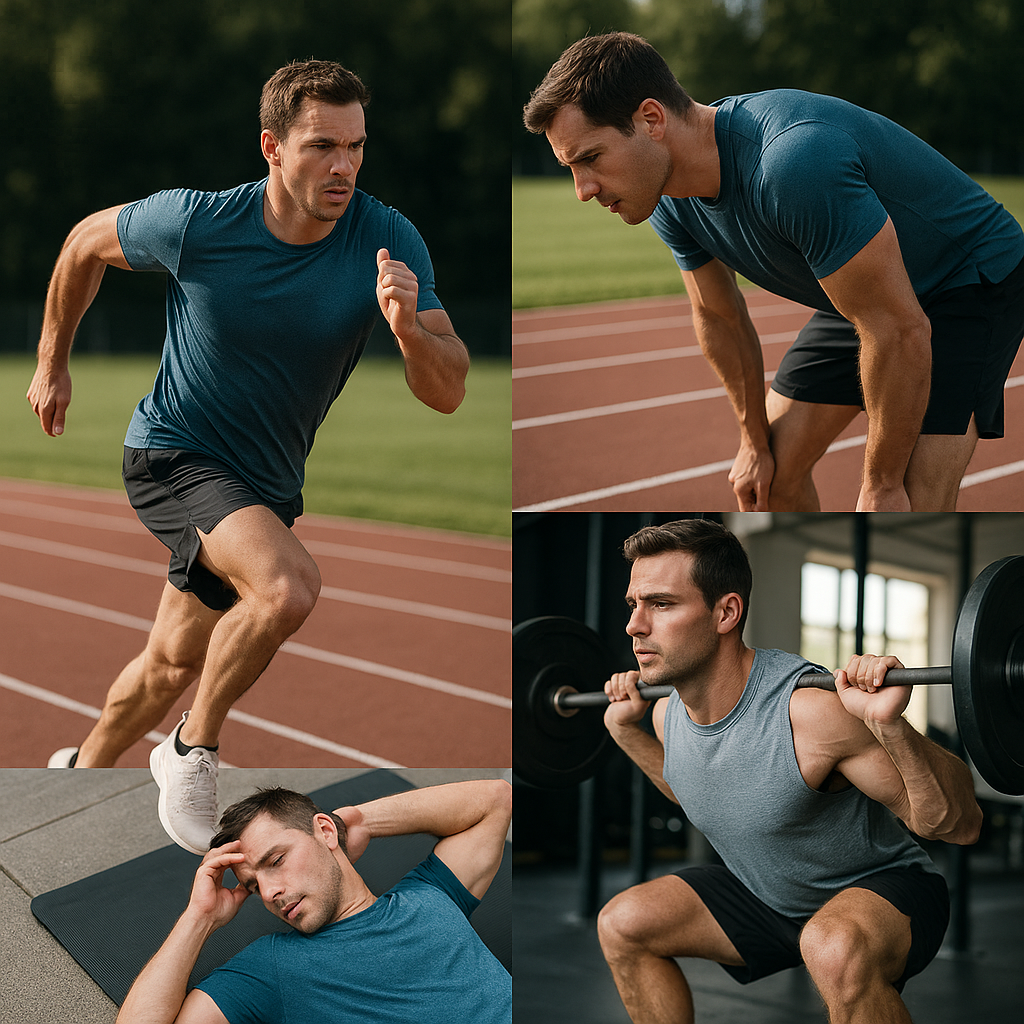
Anaerobic training is one of the fastest ways to feel stronger, more powerful, and more athletic—without spending hours exercising. If you’ve ever sprinted to catch a bus, pushed through a heavy set of squats, or done a short HIIT interval that left you breathless, you’ve already experienced it. The common thread is intensity: anaerobic work is hard, fast, and done in short bursts.
What is anaerobic training?
So, what is anaerobic training in practical terms? It’s high-intensity exercise performed in short bursts where the body primarily uses stored glucose (glycogen) rather than oxygen for energy. The word anaerobic literally means without oxygen. That doesn’t mean there’s no oxygen in your body—it means the effort is so intense that your muscles need energy faster than oxygen-based processes can deliver it.
This is the key difference compared with aerobic training (like steady cycling, jogging, or brisk walking), where you can keep going longer because oxygen helps fuel the work. Anaerobic training, on the other hand, is designed for short, demanding efforts that challenge your muscles and nervous system.
Why anaerobic training matters in a balanced routine
Many people default to cardio when they want to “get in shape,” but anaerobic training brings benefits that steady-state exercise can’t fully replace. It supports muscle strength and power, helps build or maintain lean muscle mass, and can improve metabolic health—especially when combined with regular movement and recovery.
It also fits real life. Strong hips, legs, back, and core make everyday tasks easier: lifting groceries, climbing stairs, carrying kids, or simply holding better posture through a long workday. For desk-based routines, that strength component can be a game-changer, because sitting for hours often leads to deconditioned glutes, a less stable trunk, and rounded shoulders.

Men's Posture Shirt™ - Black
Helps activate muscles and relieve tension for improved posture anytime.
Common examples of anaerobic exercise
Anaerobic training isn’t one single method—it’s a category. Popular examples include sprints, heavy strength training, and HIIT sessions that alternate intense work with rest. You’ll also see it in explosive movements like jumps and in fast-paced circuits that keep effort high.
In the next sections, we’ll break down what’s happening in your body during anaerobic work, the most effective training styles, and how to use them safely—so you can build power without sacrificing technique, joint comfort, or long-term consistency.
How anaerobic training works in the body
To understand what is anaerobic training beyond the basic definition, it helps to look at the two main energy systems your body relies on when intensity is very high. These systems produce energy quickly, but they do not last long—one reason anaerobic efforts feel powerful and then suddenly “hit a wall.”
The ATP-PC system (also called the phosphagen system) fuels very short, explosive efforts—think a heavy 1–5 rep lift, a jump, or a 5–10 second sprint. Your muscles use stored ATP and phosphocreatine to produce immediate energy. The upside is speed; the downside is that these stores run out quickly.
Anaerobic glycolysis takes over when the effort continues beyond those first seconds, roughly in the 10–90 second range for many people. Here, your body breaks down stored glucose (glycogen) to keep producing ATP without relying primarily on oxygen. This process is fast, but it also leads to the accumulation of lactate and hydrogen ions, which contributes to the burning sensation and fatigue you feel during hard intervals.
Because these systems are designed for speed and power, anaerobic training also tends to recruit more fast-twitch muscle fibers. These fibers are built for high force and rapid contraction—ideal for sprinting, lifting, and explosive movement. Training them consistently is one of the reasons anaerobic work can improve strength, speed, and overall athletic “pop.”
Effective examples of anaerobic training
Anaerobic training can look very different depending on your goals, equipment, and joint comfort. What matters is the combination of high effort, short duration, and enough rest to repeat quality work.
- High-intensity interval training (HIIT): Short bursts of near-max effort followed by rest or easy movement. Examples include 20 seconds hard/40 seconds easy on a bike, or 30 seconds fast running/60 seconds walking.
- Heavy strength training and weightlifting: Compound lifts such as squats, deadlifts, presses, and rows performed with challenging loads for low to moderate reps. Rest periods are typically longer to keep performance high.
- Sprints: Short-distance running, rowing, or cycling sprints. These can be done as repeated efforts with full or near-full recovery between rounds.
- Plyometrics: Explosive movements like box jumps, jump squats, and bounds. These are powerful tools, but they require good landing mechanics and gradual progression.
- Fast-paced circuits: Strength circuits with short work intervals (for example, 20–40 seconds per exercise) designed to keep intensity high while moving through multiple muscle groups.
If you sit for long hours, consider choosing movements that reinforce good alignment under effort: hip-hinge patterns (like deadlifts or kettlebell swings), pulling movements (rows), and core stability work (carries, anti-rotation presses). These can build strength that supports posture rather than reinforcing the rounded-shoulder, forward-head position many desk workers drift into.

Women's Posture Shirt™ - Black
Activates muscles, relieves tension, and supports posture during activity or at rest.
Key benefits of anaerobic training
Anaerobic training is often associated with performance, but its benefits go well beyond sport. When programmed well, it can improve how you move, how you feel, and how resilient your body is in everyday life.
- Muscle strength and power: Because it targets fast-twitch fibers and high-force output, anaerobic work is one of the most direct ways to build strength and explosive power.
- Increased lean muscle mass: Heavy resistance training and high-effort intervals can stimulate muscle growth and help maintain muscle as you age, supporting long-term function.
- Metabolic and weight management support: High-intensity work increases energy demand and can help improve how your body uses carbohydrates. More muscle mass also supports a higher resting energy expenditure over time.
- Bone health and joint support: Strength training places healthy stress on bones and strengthens the muscles that stabilize joints. This can be especially valuable if your daily routine is mostly seated.
- Cardiovascular and circulation benefits: While steady cardio is a classic heart-health tool, anaerobic intervals can also challenge the cardiovascular system and complement aerobic training for a more complete fitness profile.
- Blood sugar control: Because anaerobic training relies heavily on glucose and improves muscle’s ability to store and use it, it can be a helpful part of a broader plan to support stable blood sugar.
One overlooked advantage is how strength and power training can support movement quality. Strong glutes, legs, upper back, and trunk muscles help you maintain better positions—whether that’s carrying bags evenly, lifting safely, or simply staying upright at your desk without collapsing through the spine.
Why intensity needs structure
Anaerobic training is effective precisely because it is demanding. But “hard” only works when it’s paired with smart constraints: short intervals, adequate rest, and exercise choices that you can perform with solid technique. If your form breaks down, the session stops being productive and starts becoming risky—especially for the lower back, knees, and shoulders.
In the next part, we’ll turn this into practical guidance: how hard to go, how long to work and rest, how often to train, and how to progress safely so you can build power without sacrificing joint comfort or consistency.
How to train anaerobically safely
If you’re clear on what is anaerobic training, the next step is applying it in a way that builds power without sacrificing technique. Anaerobic sessions should feel challenging, but they should also feel controlled. The goal is high-quality effort repeated over multiple rounds—not a single all-out burst followed by sloppy movement.
A practical way to structure anaerobic training is to focus on three variables: intensity, interval length, and rest. Most anaerobic intervals land around 80–90% of your maximum heart rate (or an effort level where talking becomes difficult). Work intervals are typically 10–30 seconds for very high intensity, with longer rest so you can repeat the effort with good form.
Programming that supports performance and posture
Start by choosing exercises that you can perform with stable alignment. For many people—especially those who sit for long hours—this means prioritising movements that reinforce a strong hip hinge, active glutes, and an engaged upper back. Think sled pushes, cycling sprints, kettlebell swings, rows, loaded carries, or short hill sprints. If jumping bothers your knees or back, you can still train anaerobically with low-impact options like a bike, rower, or incline walk intervals.
Use these programming guidelines as a simple starting point:
- Intensity: Aim for 80–90% of max effort during work intervals.
- Duration: 10–30 seconds of hard work is enough for many anaerobic sessions.
- Work:rest ratio: Start with 1:2 (for example, 20 seconds hard, 40 seconds easy). As you adapt, you can progress toward 1:1 or even 2:1 for certain formats.
- Total volume: 6–12 hard intervals is plenty for most people, depending on the exercise and intensity.
For strength-focused anaerobic work, keep reps crisp and rest longer. A simple structure is 3–5 sets of 3–6 reps on a compound lift with 2–3 minutes of rest, stopping before technique breaks down. This keeps the session anaerobic while protecting joints and the lower back.
Frequency, recovery, and progression
Anaerobic training is demanding on muscles, connective tissue, and the nervous system. In most cases, 48 hours of recovery between hard anaerobic sessions is a smart baseline. If you’re new to this style of training, start with one session per week and build gradually as your recovery improves.
Progress should be steady and specific. Increase only one variable at a time: add one interval, slightly reduce rest, or choose a slightly more challenging variation. If you try to increase intensity, volume, and complexity all at once, form usually suffers first—especially in the hips, knees, shoulders, and lower back.
Anaerobic vs aerobic training: how they work together
Aerobic training is moderate and sustainable; anaerobic training is high-intensity and short. Aerobic work relies more on oxygen to produce energy from fats and carbohydrates, while anaerobic work relies more on stored glucose (glycogen) when the effort is too intense to sustain with oxygen-based processes alone.
In practice, they complement each other. Aerobic training supports endurance, recovery capacity, and general cardiovascular health. Anaerobic training builds strength, power, and lean muscle mass. Together, they create a more complete foundation for movement—particularly valuable if your day involves prolonged sitting. A stronger posterior chain and upper back can help you maintain better posture, while aerobic work supports circulation and energy throughout the day.
Safety essentials for high-intensity work
- Warm up 5–10 minutes: Use easy movement plus a few gradual build-up efforts before going hard.
- Prioritise technique over speed: If your spine position, knee tracking, or shoulder control breaks down, reduce intensity or switch exercises.
- Choose the right surface and equipment: Stable shoes, a predictable running surface, and appropriate loads reduce unnecessary strain.
- Stop when quality drops: Anaerobic training works best when each interval is strong and repeatable.
Frequently Asked Questions
What is the main difference between aerobic and anaerobic exercise?
Aerobic exercise is typically moderate intensity and can be sustained for longer periods because it relies more on oxygen to produce energy. Anaerobic training is high-intensity exercise performed in short bursts where the body primarily uses stored glucose (glycogen) rather than oxygen for energy.
How often should I do anaerobic training?
Most beginners do well with one session per week at first. With good recovery, many people can progress to 2 sessions per week, allowing at least 48 hours between hard anaerobic workouts.
Can anaerobic training help with weight loss?
It can support weight management by increasing overall energy demand and helping build or maintain lean muscle mass, which can raise resting energy expenditure over time. Results are best when anaerobic training is combined with regular movement, aerobic activity, and nutrition that matches your goals.
Is anaerobic training suitable for beginners?
Yes, as long as it is scaled appropriately. Beginners should start with shorter intervals, longer rest, and simple movements they can perform with solid technique (for example, cycling intervals or basic strength exercises).
What safety precautions should I take when doing anaerobic exercises?
Warm up for 5–10 minutes, focus on technique before intensity, and progress gradually. Choose exercises that feel stable for your joints and back, and stop the session if form breaks down or pain appears.
Källor
- GoodRx Health. (n.d.). "Anaerobic Exercise: What It Is and How It Works."
- Flushing Hospital Medical Center. (n.d.). "What is Anaerobic Exercise?"
- Physio-pedia. (n.d.). "Anaerobic Exercise."
- Healthline. (n.d.). "Difference Between Aerobic and Anaerobic Exercise."
- WebMD. (n.d.). "What Is Anaerobic Exercise?"
- GoodRx Health. (n.d.). "Aerobic vs. Anaerobic Exercise: What’s the Difference?"
- Human Performance Resource Center. (n.d.). "What is Anaerobic Endurance and How Do You Train It?"
- American Diabetes Association. (n.d.). "Anaerobic Exercise and Diabetes."
- Nuffield Health. (n.d.). "What is Aerobic vs. Anaerobic Training?"
- Wikipedia. (n.d.). "Anaerobic Exercise."
- Polar. (n.d.). "Anaerobic Training: What Is It and How to Do It?"
- Piedmont Healthcare. (n.d.). "The Benefits of Anaerobic Exercise."
- National Center for Biotechnology Information. (2017). "The Effect of Anaerobic Exercise on Health."